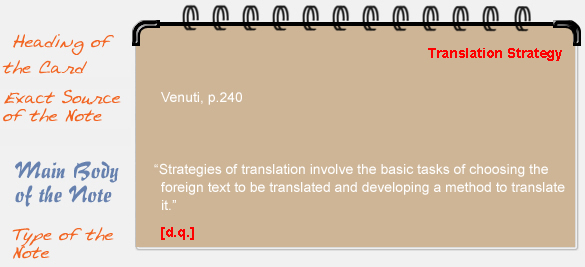
The sample note card in the preceding
task gives you a general picture of what a note card must
contain: the note itself and the source of the note. You
may then wonder what exactly makes a note. Note may be
a direct quotation, a paraphrase, or a summary. They won't
be used until the write-up but preparations must be under
way in the course of your reading. The sample note card in the preceding
task gives you a general picture of what a note card must
contain: the note itself and the source of the note. You
may then wonder what exactly makes a note. Note may be
a direct quotation, a paraphrase, or a summary. They won't
be used until the write-up but preparations must be under
way in the course of your reading.
A direct quotation is an exact copy of a portion in
the original text. It should be used sparingly and is
usually used on the following occasions: (1) when authority
is desirable for controversial positions; (2) when the
original wording is so inventive or forceful that it
will lend power to your work; and (3) when the accuracy
of the original statement is extremely important. A
direct quotation should not be too long and has to be
enclosed by quotation marks. At times you may wish to
leave out a phrase, a sentence, or more, from the original.
Use three spaced dots (an ellipsis) to indicate the
omission. Never alter the meaning of the original by
using an ellipsis and make sure that you still have
a complete sentence after you use the ellipsis. If the
original has an obvious error, copy the error and follow
it with [sic], the Latin word for "thus".
A paraphrase is a restatement of the author's ideas
in about the same number of words. A summary is a brief
synthesis of a large amount of information in the original
in your own words. Writing a paraphrase or a summary
requires you to identify the essential ideas and terminology
in your source.
If the source appears in other languages than English,
you will have to translate the part you want to quote
from the original since you are supposed to write in
English. Make sure that you have not altered the meaning
of the original in translating.
Insert a brief editorial remark at the lower left corner
of the card indicating the type of the note. You may
use abbreviations. For example, [d.q.] stands for a
direct quotation; [p.] stands for a paraphrase; [s.]
stands for a summary; and [tr.] stands for your translation.
This information will help you decide on the ways to
use it in the write-up.
When you find that additional references are merely
repeating the information you already have, it is time
to stop reading awhile and put your note cards in order.
Reread your notes to refresh your memory and at the
same time put them into groups under different headings.
Do not try to be creative here and write a different
heading for each card; you should have several cards
with the same heading. Reference to the headings you
use in the outline may be helpful here. Place a brief
heading at the upper right corner of the card.
This rereading and grouping may help you assess the
notes you have. Some notes, you will find, should be
discarded because they do not shed light on your particular
topic; others should be supported by additional references.
By now you will have a much better idea of what you
are going to write.  So
now is a good time to go back to the library to try
and see whether there is anything relevant that you
have missed. So
now is a good time to go back to the library to try
and see whether there is anything relevant that you
have missed.
|